Fintech Startup Funding in Singapore
Singapore’s fintech revolution is in full swing. The sector reached USD 911.3 million in 2024 and is projected to grow at 12% annually, reaching USD 2.5 billion by 2033. This explosive growth has made Singapore Southeast Asia’s undisputed fintech capital, but it’s also created a unique challenge for entrepreneurs.
Traditional banks simply don’t understand fintech business models. While Singapore hosts 487 active fintech companies, many founders still struggle to secure funding from conventional lenders who prefer brick-and-mortar businesses with physical collateral over innovative technology platforms.
That’s where Funding Societies steps in. Founded in 2015, Funding Societies is the largest SME digital financing platform in Southeast Asia, having disbursed over SG$6 billion to more than 100,000 SMEs across Singapore, Indonesia, Malaysia, Thailand, and Vietnam. In Singapore, FS Capital Pte. Ltd. is a licensed entity regulated by the Monetary Authority of Singapore, offering working capital loans, invoice financing, and property-backed loans.
Leveraging technology and secure digital channels, we streamline applications, assessment, and disbursement to enable SMEs to access funding quickly and transparently. Our digital-first approach supports efficient, compliant exchange of documents, empowering companies to manage cash flow, fund growth, and seize opportunities with confidence.
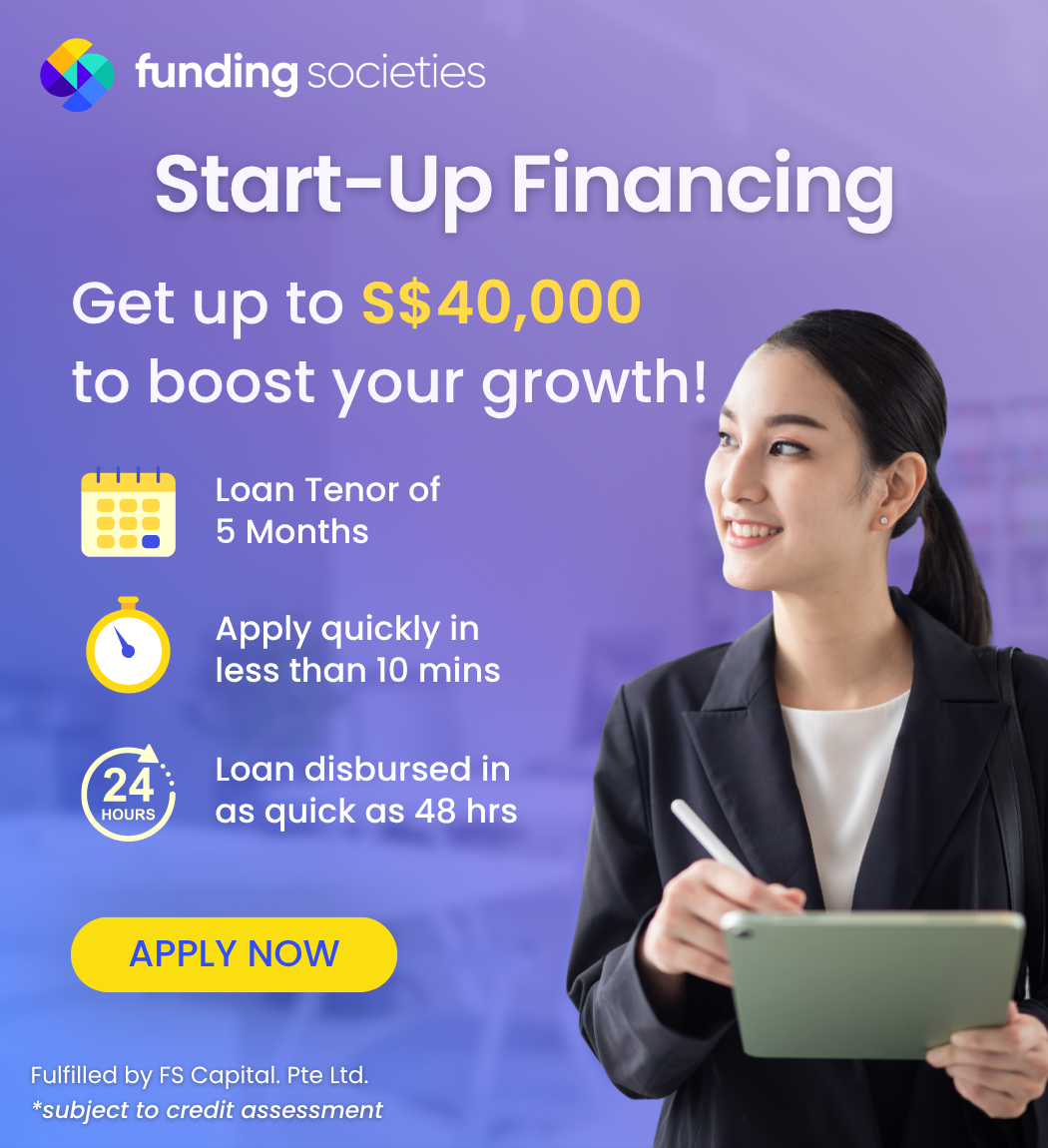
Fintech startups at an early stage can look at Start-Up Financing, an online loan from Funding Societies built for newer businesses. The application is fully online, decisions are quick, and repayment follows a fixed, short schedule, which makes it easier to plan around costs such as MVP development and initial working capital. To see who can apply, which documents to prepare and how the process works, read our guide to Start-Up Financing eligibility and how to apply. Approval and terms are subject to assessment.
Singapore’s Fintech Boom: Market Size and Opportunities
Singapore has become Asia’s fintech powerhouse for good reason. The market reached USD 911.3 million in 2024³ and continues growing at a robust 12% annually⁴. This isn’t just numbers on a spreadsheet – it represents real opportunities for fintech entrepreneurs who can tap into Southeast Asia’s massive underbanked population.
The ecosystem now includes 487 active fintech companies⁵, spanning everything from digital payments to regulatory technology. The government has backed this growth with S$150 million through the Financial Sector Technology and Innovation (FSTI 3.0) scheme⁶, demonstrating serious commitment to making Singapore the region’s fintech hub.
What’s particularly impressive is Singapore’s regional dominance. The city-state captures 59% of all ASEAN fintech funding⁷, making it the natural choice for entrepreneurs looking to scale across Southeast Asia’s 650 million potential customers.
According to the 2024 Singapore Fintech Report⁸, the industry breaks down into several key segments. Payments companies represent the largest group at 27.2% of the ecosystem, followed by RegTech at 12.6%, WealthTech at 11.8%, and the rapidly growing Blockchain/Web3.0 sector at 8.8%. InsurTech and ESGTech are also emerging as significant growth areas.
Why Traditional Banks Struggle with Fintech Funding
Here’s the uncomfortable truth: traditional banks weren’t built for the fintech era. Their risk assessment models focus on physical assets and proven cash flows, not the intellectual property and scalable technology platforms that define modern fintech companies.
The typical bank loan process is lengthy and requires extensive collateral. Fintech startups, by nature, are asset-light businesses where value lies in code, algorithms, and user data rather than real estate or tangible assets. When a payments startup walks into a bank asking for funding to scale their API, loan officers often don’t know how to evaluate the opportunity.
Regulatory complexity adds another layer of difficulty. Banks want to see MAS licensing, Payment Services Act compliance, and comprehensive AML/CFT frameworks before considering a loan. While these requirements make sense, they can create chicken-and-egg situations where startups need funding to achieve compliance but can’t get funding without compliance.
The result? Innovative fintech companies waste months navigating bureaucratic processes when they should be focused on building products and acquiring customers.
Complete Guide to Fintech Startup Funding Options in Singapore
Which Funding Options Can Fintech Startups Use?
Fintech startups in Singapore can choose from several funding types depending on their stage and needs. Here is how they compare:
| Financing Type | Best Use Case |
| Start-Up Financing | Early-stage MVP development, initial working capital |
| Working Capital Loan | Scaling operations, technology development, team hiring |
| Invoice Financing | Cash flow from B2B fintech services, accounts receivable |
Government Support and Alternative Funding Landscape
For a wider look at funding that does not need repaying, see our guide to SME grants in Singapore.
Singapore’s government recognizes fintech as a strategic priority, creating multiple funding channels beyond traditional commercial lending. The Monetary Authority of Singapore leads this effort through the Financial Sector Technology and Innovation (FSTI 3.0) scheme, which commits S$150 million over three years to support fintech innovation⁹.
The FSTI program focuses on cutting-edge areas including artificial intelligence, data analytics, regulatory technology, cybersecurity, and ESG fintech solutions. Companies can receive proof-of-concept grants, hiring support for specialized talent, and business development assistance for international expansion.
Enterprise Singapore complements MAS efforts through several startup-focused programs¹². The Startup SG Founder grant provides up to S$50,000 in equity-free funding for new entrepreneurs, while Startup SG Equity enables government co-investment alongside qualified private investors. Startup SG Tech specifically supports commercialization of innovative technologies.
Recent funding data shows Singapore maintained its regional leadership position with US$955 million in fintech funding during 2024, despite a broader 23% decline in Southeast Asian fintech investment¹³. This resilience demonstrates the strength of Singapore’s fintech ecosystem and the continued confidence of both local and international investors.
The top funded Singapore fintech in 2024 include established players like Coda Payments with US$715 million in total funding and Advance Intelligence Group with US$700 million¹⁴. Digital banks also attracted significant capital, with ANEXT Bank raising US$359 million in their Series D round.
Looking Ahead: Singapore’s Fintech Future
Singapore’s fintech sector shows no signs of slowing down. The combination of government support, regulatory clarity, and regional market access continues attracting entrepreneurs and investors from around the world. As the sector matures, we expect to see more specialization in areas like ESG fintech, quantum computing applications, and cross-border payment solutions.
For fintech entrepreneurs, this represents an unprecedented opportunity. The infrastructure exists to support rapid scaling, the regulatory environment encourages innovation, and the funding landscape includes both government grants and private capital. The key is choosing partners who understand your industry and can provide the right combination of capital, expertise, and support.
At Funding Societies, we’re proud to be part of Singapore’s fintech success story. Whether you’re developing the next breakthrough in digital payments, building regulatory technology solutions, or creating innovative wealth management platforms, we understand your journey and are here to support your success.
FAQs
Can fintech startups apply for Start-Up Financing?
Start-Up Financing is open to eligible early-stage businesses registered in Singapore, across a range of industries. Eligibility depends on the business, so check the guide for current requirements.
How do I apply for Start-Up Financing?
The application is completed online. The guide covers the documents to prepare and the steps involved.
What other funding options are there for fintech startups?
Working capital loans and invoice financing can suit more established businesses, and government grants and equity investment are other routes. The right mix depends on your stage and cash flow.
Related reading
References & Sources
¹ IMARC Group. (2024). Singapore Fintech Market Size & Analysis | Forecast 2033. Retrieved from: https://www.imarcgroup.com/singapore-fintech-market
² Fintech News Singapore. (2024). Singapore Fintech Report 2024. Retrieved from: https://fintechnews.sg/103040/fintech/singapore-fintech-report-2024-summary/
³ IMARC Group. (2024). Singapore Fintech Market Report. Retrieved from: https://www.imarcgroup.com/singapore-fintech-market
⁴ IMARC Group. (2024). Singapore Fintech Market Size & Analysis | Forecast 2033. Retrieved from: https://www.imarcgroup.com/singapore-fintech-market
⁵ Fintech News Singapore. (2024). Singapore Fintech Report 2024: 487 Fintech Companies Identified. Retrieved from: https://fintechnews.sg/103040/fintech/singapore-fintech-report-2024-summary/
⁶ International Comparative Legal Guide (ICLG). (2024). Fintech Laws and Regulations Report 2024-2025 Singapore. Retrieved from: https://iclg.com/practice-areas/fintech-laws-and-regulations/singapore
⁷ Tenity. (2024). Fintech in Singapore: What you need to know. Retrieved from: https://www.tenity.com/blog/fintech-singapore
⁸ Fintech News Singapore. (2024). Singapore Fintech Report 2024. Retrieved from: https://fintechnews.sg/103040/fintech/singapore-fintech-report-2024-summary/
⁹ International Comparative Legal Guide (ICLG). (2024). Fintech Laws and Regulations Report 2024-2025 Singapore. Retrieved from: https://iclg.com/practice-areas/fintech-laws-and-regulations/singapore
¹⁰ Monetary Authority of Singapore (MAS). (2024). FinTech and Innovation. Retrieved from: https://www.mas.gov.sg/development/fintech
¹¹ Monetary Authority of Singapore (MAS). (2024). FinTech and Innovation. Retrieved from: https://www.mas.gov.sg/development/fintech
¹² International Comparative Legal Guide (ICLG). (2024). Fintech Laws and Regulations Report 2024-2025 Singapore. Retrieved from: https://iclg.com/practice-areas/fintech-laws-and-regulations/singapore
¹³ Fintech News Singapore. (2025). Southeast Asia Fintech Funding Cools with 23% Dip in 2024, Singapore Maintains Lead. Retrieved from: https://fintechnews.sg/106300/funding/southeast-asia-fintech-funding-2024/
¹⁴ Fintech News Singapore. (2024). Top Funded Fintechs in Singapore 2024. Retrieved from: https://fintechnews.sg/84221/funding/top-funded-fintechs-in-singapore-2024/
Additional Industry Sources
- PwC Singapore. (2024). FinTech’s state of play 2.0: Understanding Singapore’s FinTech landscape 2024. Retrieved from: https://www.pwc.com/sg/en/publications/fintech-state-of-play.html
- Mordor Intelligence. (2024). Singapore Fintech Market Size, Share & Growth Analysis. Retrieved from: https://www.mordorintelligence.com/industry-reports/singapore-fintech-market
- Statista. (2024). FinTech – Singapore Market Forecast. Retrieved from: https://www.statista.com/outlook/dmo/fintech/singapore
- Government of Canada Trade Commissioner Service. (2023). Fintech market in Singapore. Retrieved from: https://www.tradecommissioner.gc.ca/singapore-singapour/market-reports-etudes-de-marches/0006559.aspx?lang=eng
Regulatory and Government Sources
- Monetary Authority of Singapore (MAS). FinTech and Innovation Portal. Retrieved from: https://www.mas.gov.sg/development/fintech
- Enterprise Singapore. Startup Support Programs. Retrieved from: https://www.enterprisesg.gov.sg/grow-your-business/startup-support
- Accounting and Corporate Regulatory Authority (ACRA). Business Registration Statistics. Retrieved from: https://www.acra.gov.sg/corporate-information/statistics

- CBS Credit Report Singapore: What Business Lenders Check Before an SME Loan - October 12, 2026
- SME Grants in Singapore (2026): What’s Open, What Changed and How to Apply - September 30, 2026
- 9 Financial Habits of Successful Singapore SME Owners - August 5, 2026